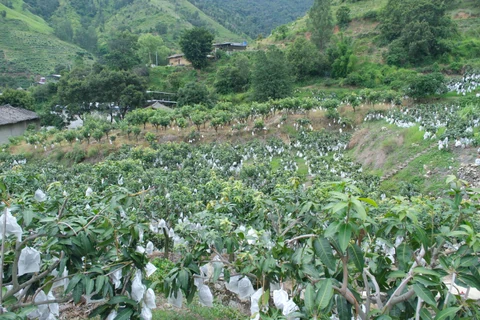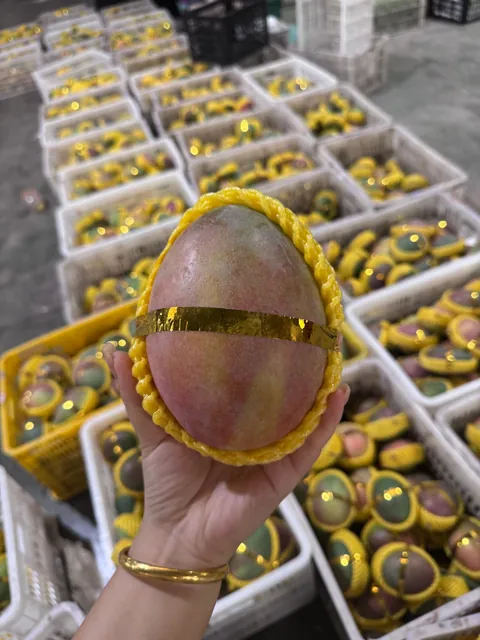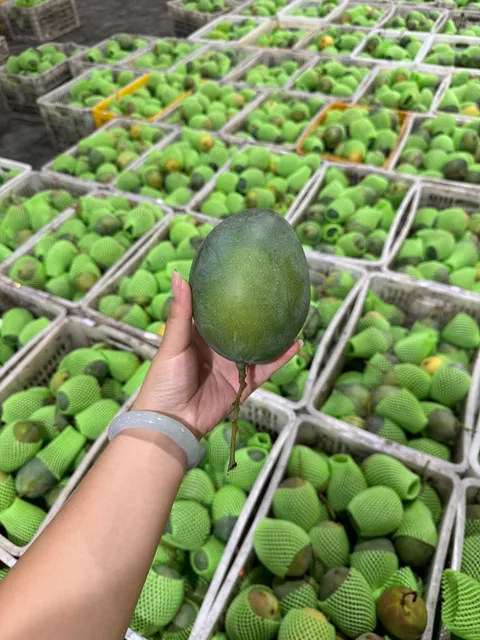
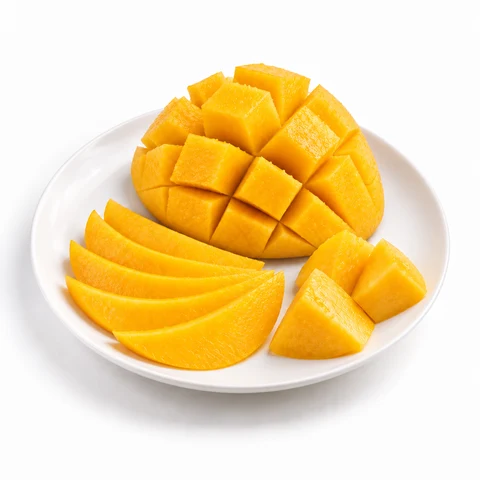
01 / START WITH THE PRODUCT
Your finished cut.
Your starting point.
A useful trial brings procurement and production around the same question: will this whole fruit work for the product you plan to make?
The National Mango Board describes Keitt as a large, oval mango with firm, juicy flesh and limited fibres. A trial shows how the offered lot performs with your method, tools and finished-product standard.
Define what you will use.
Specify cubes, slices or another format, with the dimensions and tolerances, texture, appearance and defect limits your team needs. Count only pieces meeting that standard as usable output; weigh fruit intended for other applications separately.
Choose and identify the sample.
Record the lot, packs sampled, fruit count and selection method. Keep size and starting condition visible. A sample chosen for appearance alone cannot describe the full lot’s performance.
Record the fruit at preparation.
Assess maturity and firmness using your stated method. Log any holding or ripening between receipt and cutting. Green, Yellow and Rainbow are appearances of the same Keitt variety; the colour name does not define readiness for your process.
The UF/IFAS fresh-cut mango manual explains why fruit condition at receiving and preparation matters. Set the trial under your processing team’s established hygiene and handling controls.

02 / FOLLOW THE FRUIT BY WEIGHT
Weigh the input.
Make the output count.
Keep the receiving sample and the fruit entering preparation separate. Use net fruit weights, tared containers and the same weight unit throughout.
- R Received sample
- The whole-fruit sample allocated to this trial, weighed before receiving exclusions. Record the fruit count and any fruit removed, held aside or used for other assessments.
- P Preparation input
- The whole fruit actually entering cutting, weighed at preparation. Record exclusions and any change during holding; do not assume this equals receiving weight minus rejects.
- U Usable output
- Prepared fruit meeting the cut specification set before the trial. Exclude packaging, added ingredients and pieces allocated to a different finished product.
PREPARATION YIELD (%)
Usable prepared fruit weight
divided by actual whole-fruit preparation input multiplied by 100
In the record: U ÷ P × 100. A measured zero output gives 0% when input is positive. Missing weights or zero input leave the calculation open.
Account for each output once.
Weigh usable output, peel, stone, trim, quality rejects, other product outputs and other measured losses as separate, non-overlapping categories. State the weighing and drainage method so attached water or juice is handled consistently.
Complete the balance only when every output stream is measured or confirmed zero. Record the signed difference between preparation input and the sum of measured outputs. Investigate it rather than assigning it to “normal waste” to make the figures balance.
For the buying view: usable output ÷ received sample weight × 100 can show received-fruit yield only when that same sample is fully followed through the trial. Every allocated fruit needs a final disposition; leave this result open while any fruit remains unresolved. Account for exclusions and holding changes. Do not divide a small trial’s output by the whole delivery weight.
03 / THE WORK BETWEEN THE WEIGHTS
Track the time.
And the people.
Record elapsed time and the minutes each operator spends on the included tasks. Two people working together do not contribute the same labour as one person over the same elapsed time.
Elapsed minutes
The time between the stated start and finish. Note pauses and the stages covered.
Person-minutes
The sum of each operator’s active minutes on those same tasks.
Labour minutes per usable kg
Total person-minutes ÷ usable output in kilograms
State whether sorting, peeling, cutting, packing or cleaning is included. If usable output is zero, labour per usable kilogram cannot be calculated. Keep missing information blank rather than entering zero.
04 / KEEP THE LOT WITH THE RESULT
A useful record.
Ready for your team.
Give the trial an ID and keep the original measurements, photographs and selection notes together. The record should let another member of your team understand what was tested and reproduce the calculation.
Scroll sideways when needed to read all three columns.
| Measure | Keep in the record | Use it to assess |
|---|---|---|
| Sample & lot | Origin, cultivar, appearance, pack references, sample selection, count and fruit sizes | What the trial represents |
| Condition & dates | Receipt and preparation dates, maturity/firmness methods, defects and any holding steps | Fit with the preparation schedule |
| Weight streams | Received sample, actual preparation input, each output category, weighing method and signed difference | Usable output on a defined basis |
| Time & tasks | Operators, tools, included stages, elapsed time and active person-minutes | Work needed per usable kilogram |
| Finished cut | Cut dimensions/tolerances, texture, appearance, acceptance limits and rejection reasons | Fit with your finished-product standard |
| Holding observations | Optional: finished pack, actual conditions, assessment times and your quality/safety checks | Observed performance under those conditions |
TAKE IT INTO YOUR NEXT TRIAL
A blank record.
A clearer conversation.
Editable text with the sample, weight balance, yield, labour and comparison fields in one place.
Blank template · manual calculations · no performance assumptions
05 / READ THE RESULTS TOGETHER
Yield. Quality. Work.
One buying decision.
Read yield alongside labour and finished quality. A higher percentage is useful only if the output meets the product standard your team intends to sell or serve.
- Keep the comparison consistent. Use the same cut and acceptance criteria, comparable maturity at preparation, and a recorded method. Note changes in size, tools, operators or holding.
- Keep each run visible. Convert comparable runs to the same weight unit before combining them. Calculate total usable output ÷ total preparation input × 100. Do not simply average their percentages when input weights differ.
- Check further lots. One selected sample describes that trial. Repeat with additional lots before treating its result as typical supply performance.
Your qualified processing team sets and validates hygiene controls and finished-product shelf life. The FDA’s August 2026 fresh-cut produce guidance provides context for relevant US ready-to-eat processing operations. Yield, appearance and holding observations do not establish food safety.
GOOD FRUIT. YOUR NEXT CUT.
Your preparation.
Our whole fresh Keitt.
Tell us what you plan to make, the fruit size and receiving condition you need, your destination, arrival window and total quantity. Include the preferred appearance and kilograms per pack so we can discuss whole-fruit supply around your process.
Commercial orders start at a total of 10 tonnes. Sample availability, delivery and costs are agreed separately. Explore our fruit and packing options, or share the completed record in your next conversation with us.
Sources & scope
- National Mango Board, Keitt — general cultivar characteristics.
- UF/IFAS, Fresh-Cut Mango Best Management Practices Manual (HS1443) — fruit condition, preparation and recordkeeping context for US fresh-cut mango operations.
- US FDA, Guide to Minimize Biological Hazards in Ready-to-Eat Fresh-Cut Produce — final guidance, August 2026; scope defined by the FDA.
Sources checked 4 October 2026. This guide and its blank record support procurement and preparation evaluation. They are not a food-safety validation protocol, a finished-product supply offer or a SHINEMANGO yield/shelf-life guarantee.